

Make agents part of how your company works.
Four ways in
Section titled “Four ways in”These docs are for anyone whose organisation uses Emargen, from the day you’re invited. Pick the path that fits you, and read it in order.
- New to EmargenWhat Emargen is
Teams in silos, people and agents on the same work, and the kinds of work you do in Emargen.
- Your first dayYour first hour
From the invitation in your email to a first topic about something from your own work.
- An administratorSetting up an organisation
For the administrator who brings Emargen in: its AI, its knowledge, its code and its people, then the launch.
- An engineer with a coding agentFor engineers
Connect Claude Code or Codex: it reads the plan the team agreed, builds it in pieces you can each show working, and leaves notes that come back to the team.
People and agents on the same work
Section titled “People and agents on the same work”You bring the work, like a customer’s question, research for a decision or a process that waits between teams. The agent reads what your organisation has connected, asks what’s missing and lays out the options. You decide. What you work out stays, so colleagues and their agents build on it.
- Company knowledgeYour connected tools and documents, your code, and what colleagues worked out before, each with its source.
- Agents with responsibilitiesSet up for different kinds of work, each with its own instructions, skills and model.
- People with agencyThey set the direction, review what matters and make the decisions.
What Emargen is covers all of it.
The areas
Section titled “The areas”Your area has its own section. The Glossary lists the words Emargen uses.
- Topics
Where most work happens. Research, an idea, a plan, a decision or a customer’s question, worked through with the agent into a document your colleagues find.
- Initiatives
For when something should be built. Shaped with the agent, checked against the code, approved, and built in slices.
- Inbox
One stream of everything that arrived for you, with what you have to reply to and do at the top.
- Decisions
What waits on you to decide, answer or approve, settled where you read it, and a map of what was decided.
- Calendar
What is due and what happened, and the jobs the agent does for you on a schedule.
- Workspace
The organisation’s one workspace, every team’s home: boards, lists, labels, fields, and your organisation’s own words for its systems, roles and terms.
- Agents
The agent beside every page, and how your team makes it work its way: the approach it takes to a job, the know-how it brings, the shape its documents take, the steps a kind of work follows, and the apps built for your team.
- Academy
Learning what your organisation knows at your own pace: tracks you choose, a few cards of practice a day, and challenges with a colleague.
- Admin
Setting up and running the organisation: its models, connections, repositories, people and roles, its plan, and the record of AI use.
- For engineers
Coding agents in Emargen: what they read, what they build and what they leave behind.
- Getting around
The menu, the search, the chat beside every page, and your own profile.
- Glossary
Every Emargen word in a line, each linking to its page.
The company in the pictures
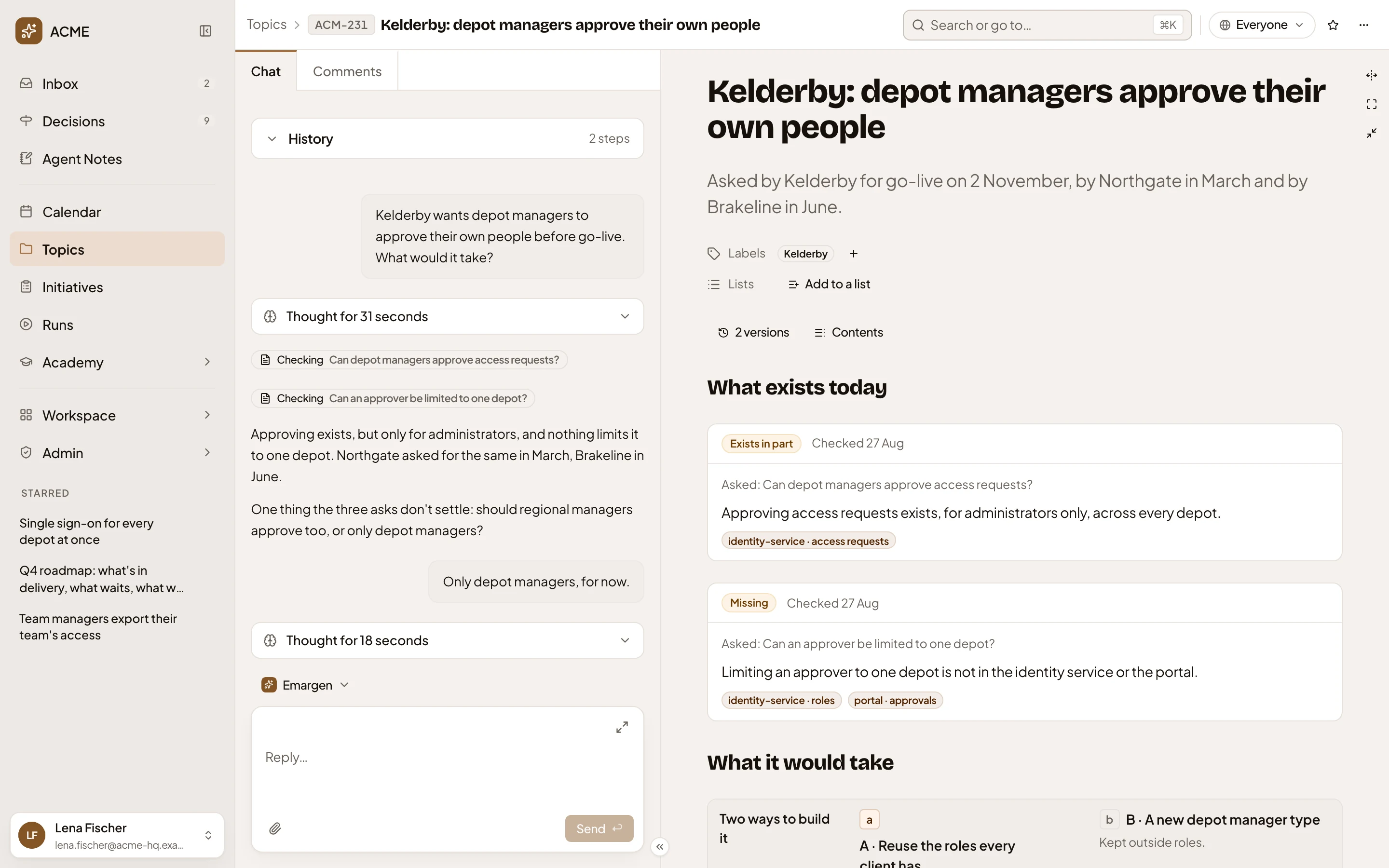
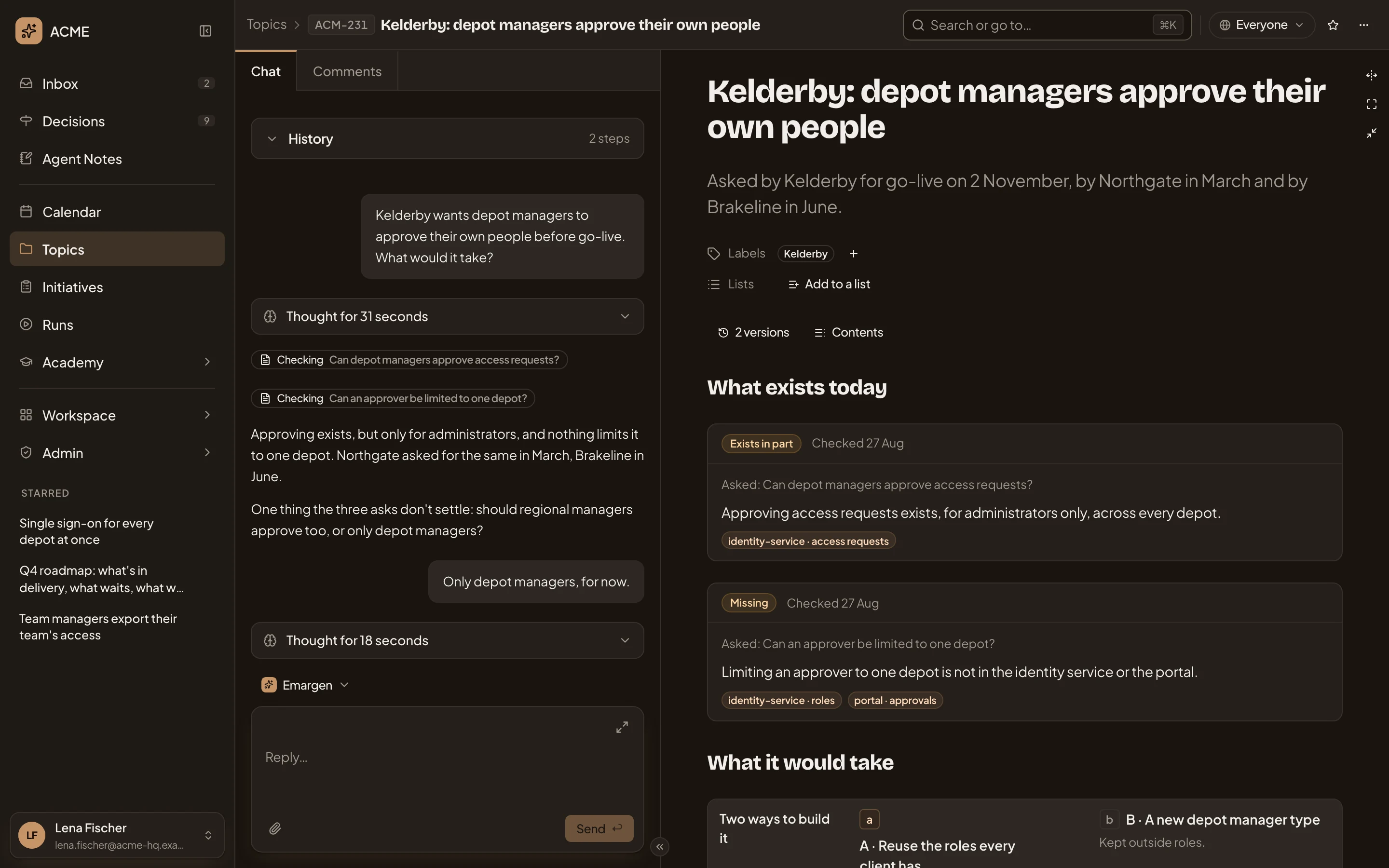
Section titled “The company in the pictures”The pictures show ACME on Friday 30 October 2026, six months after it started using Emargen. It’s a made-up company that makes access and sign-in software for logistics and food companies. Most of the pictures follow six of its people, each doing their own work.
- Ana Ruiz, in customer success, plans a customer’s go-live in a topic, and found out with the agent whether a customer’s team managers can export their team’s access.
- Tom Weber, in sales, works a customer’s security questionnaire through in a topic of his own.
- Ines Costa, in support, keeps a board the agent fills with customers’ questions.
- Lena Fischer, in product, thinks a customer’s request through with the agent before anything is built, and approves what gets built.
- Mira Holm, in security, had the first day every new joiner has, and owns an initiative that engineers have since built.
- Jonas Berg, in engineering, built that initiative with Claude Code, whose notes come back to him.