

Area of Emargen
Academy
The Academy is for the things you’d rather know than look up. The systems you’re about to work on, the roles at your customers, and the words your colleagues use. It turns what you ask into short questions, a few a day, until it sticks.
Knowing it, not finding it
Section titled “Knowing it, not finding it”Emargen holds a lot of what your organisation knows, and its agent finds it for you when you ask. But knowing where something is written isn’t knowing it. People forget what a system does, or which role a request goes to. They find out in the middle of a customer call. A new joiner reads everything in their first week and keeps little of it. When a definition changes, the people who learned the old one are the last to hear.
Flashcard tools work on cards you write yourself. Here, questions come from your organisation’s words, and change with the facts. The Academy checks a written answer by its meaning, and spaces your practice so your time goes to what you keep missing.
A track, built with the agent
Section titled “A track, built with the agent”You start a track on Tracks by telling the Academy agent what you want to learn and why. Today it draws on your organisation’s Landscape, its agreed descriptions of its systems, roles and terms. The agent looks through it, picks the entries your request touches and shows them on your map. Then it asks a few things, one at a time. What will you do with it? How deep should it go? What should it leave out, and what do you know already? When you name something the Landscape doesn’t hold, it says so instead of making it up.
You decide when to build it. The agent never does it for you. It then writes the facts and the questions for each entry in the background, checks each fact against its source, and tells you in your Inbox when the track is ready.
A few minutes a day
Section titled “A few minutes a day”Practice gives you a few cards on a morning when some are due. You answer, say how sure you are, and Emargen checks the answer. A written one is read for its meaning, point by point, and the check quotes the source. What you missed comes back sooner. What you knew comes back later each time.
The facts belong to the organisation, so everyone who practises one practises the same words. When something changes, anyone who practises it asks the agent to rewrite the fact. Everyone else sees it marked Changed, and it starts over in their practice.
How you do is yours alone. Nobody else sees what you practise or how you answer, administrators included. There are no points, streaks or leaderboards.
Ask about anything
Section titled “Ask about anything”Not everything you want to learn needs a track. Explore is a chat where you ask about anything you want to understand at work. It answers from what your organisation has connected, the record and the Landscape, and starts from what you already practise. You can ask it to explain something, walk you through it, or quiz you on it.
Once a day, an agent reads your Explore chats and your practice together, and writes your learning profile. It notes what you’re curious about, what you’re strong in and what you keep forgetting. When a subject keeps coming back, it suggests a track, and you make it with one press.
Your map
Section titled “Your map”The Academy opens on a map of what you practise, coloured by how well you’d recall each fact today. Dashed islands show the parts of the Landscape your tracks don’t cover yet, so you can see what you haven’t chosen to know.
Your map also holds Emargen’s own ideas, built from these docs. Your first day’s task in the Inbox takes you there. Practise How Emargen works, and you learn the app the same way you learn your organisation.
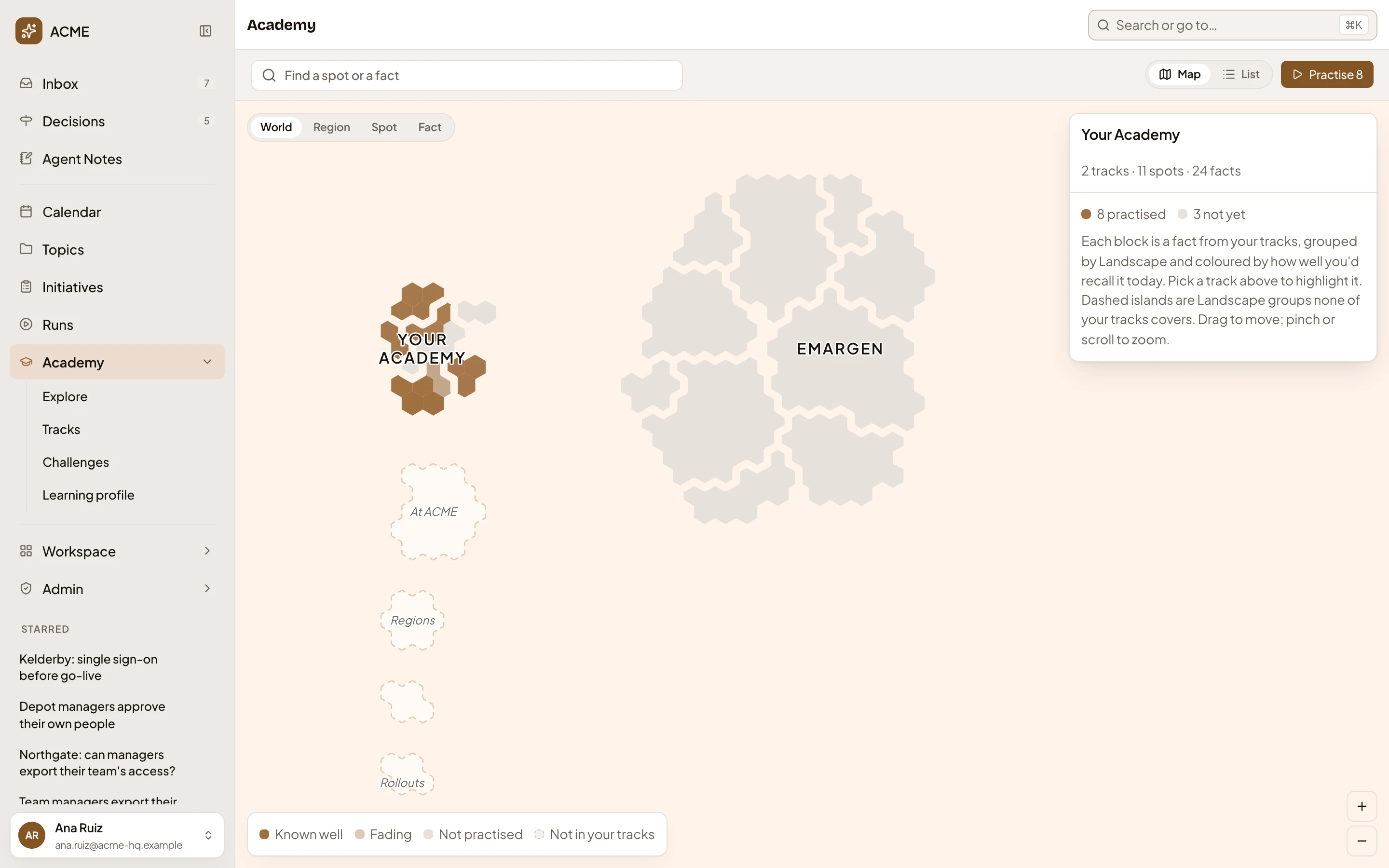
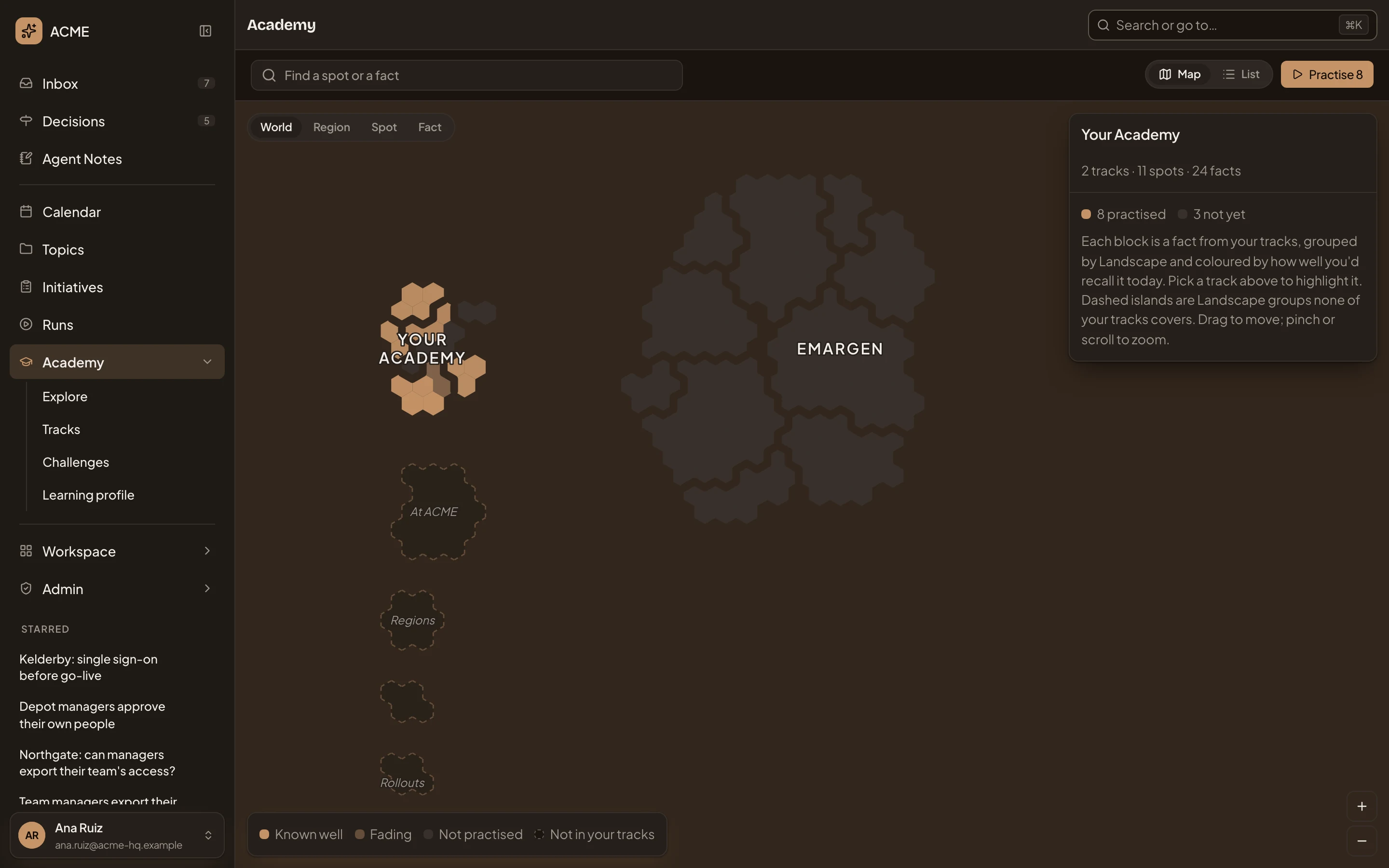
- Your own tracks. Each block is a fact, coloured by how well you’d recall it today.
- The colours, from Known well to Not practised.
- A part of the Landscape none of your tracks covers yet.
- Emargen’s own ideas, written from these docs, not practised yet.
- Practise 8: today’s cards.
Three weeks before a go-live
Section titled “Three weeks before a go-live”A customer with 25 depots goes live in three weeks, and you, in customer success, will be explaining sign-in and approvals to its depot managers. You tell the Academy agent so. It picks nine entries from the Landscape, from single sign-on to the customer portal. You choose to explain it to customers, down to how the parts work together, and build it. The next morning your Inbox holds today’s practice: six cards, about three minutes.
Then your organisation changes how approvals work, and depot managers now approve their own people. You ask the agent to rewrite the fact on Approver, and everyone who practises it sees the change.
Along the way you ask Explore twice who approves a request while a depot’s manager is away. The next time your profile is written, Tracks suggests a track on it.
Beside the rest of Emargen
Section titled “Beside the rest of Emargen”Your workspace keeps the Landscape that tracks draw on, and what’s due arrives in your Inbox. A colleague can challenge you on the same cards. A model your administrators set up checks written answers, and without one, you get the other kinds of card.