

InitiativesIdea
Slices and tasks
A slice is one step of an initiative that you can show working on its own. A task is one piece of a slice’s work, usually in one repository. People build the tasks with their own coding agents, like Claude Code or Codex.
Something to show at every step
Section titled “Something to show at every step”Built all at once, an initiative shows nothing until everything works. When a customer asks what works already, the answer is a guess.
A slice is a step, in the order you’ll build them. It has a demo: one sentence saying what anyone can see working when it’s done. Take an initiative that switches all of a customer’s depots to single sign-on at once. Its first slice is done when someone tests sign-in for three depots and sees which passed, which failed and which never ran. Its second is done when an administrator switches every tested depot on in one go, then switches one back alone. A product manager knows what to look at, and someone in customer success can tell the customer which part works.
The agent cuts the slices from the decomposition when you ask, and breaks each one into tasks. Before approval they’re a plan, and whoever edits the initiative can have them cut again. After approval, changing the slices takes a change request.
Tasks, taken by coding agents
Section titled “Tasks, taken by coding agents”A task says what to do, and in which repository. On that second slice, one task makes the sign-in service switch every tested depot on in one request. Another puts the button for it in the portal’s single sign-on settings.
A person’s coding agent, connected to Emargen, claims a task, builds it, and closes it with its merge request. Nobody hands out tasks on the page, and nobody reports progress. You see who took each task, which agent they used, and where it stands. Two engineers can build one slice side by side, each with their own coding agent. An agent can also add a task when it finds more work while building another.
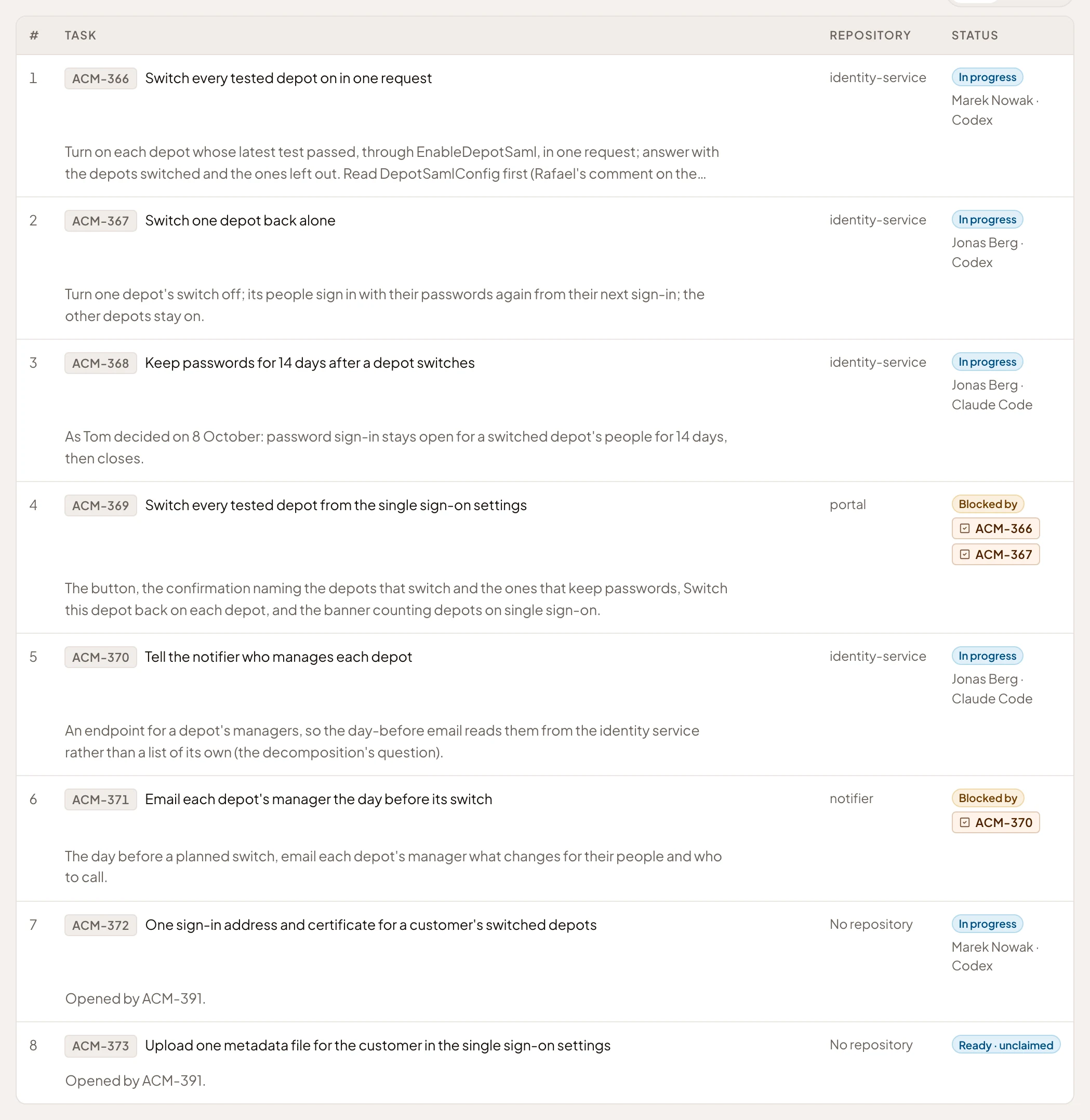
- A task: what to do.
- The repository it’s built in.
- Where it stands, and who took it with which coding agent. This one is being built with Codex.
- Another engineer’s task, being built with Claude Code.
- A task that can’t start yet. Two others block it.
- A task nobody has taken yet, ready for anyone’s agent.
Blocked by, and blocks
Section titled “Blocked by, and blocks”Some work needs other work first. The portal’s button needs the sign-in service to switch the depots on, and to switch one back. So a task can be blocked by another task, in any slice, or by a whole slice. Most tasks are blocked by nothing.
A blocked task can’t be claimed. The agent that tries is told what blocks it, and takes another task. A slice stops blocking once all its tasks are closed, or once it’s marked done.
A coding agent can also say that a task it claimed is blocked, when it finds the task needs another task’s output first. The task shows as blocked until that one closes.
Done is a person’s call
Section titled “Done is a person’s call”A slice starts when an agent claims its first task, or when someone who edits the initiative starts it by hand. The owner or an editor blocks a slice when it can’t go on, and says why. They unblock it, call it done, or reopen it. Every move is kept, with who made it and when.
A slice whose tasks are all closed still isn’t done. Emargen asks the owner to check the demo and mark the slice done. Seeing it work is why a person makes that call, not an agent. Delivery shows how far the slices have come.