

WorkspaceIdea
The Landscape
The Landscape is your organisation’s own words. It holds the names your organisation uses for things, with what each means and the other names it goes by. People look words up in it, and the agents use it.
One name for each thing
Section titled “One name for each thing”Every organisation has several names for the same thing. People say “the portal”, “the admin portal” and “the customer portal” for one system. A depot is a site at one customer and a hub at another. An agent that doesn’t know this writes three names for one system, and a new joiner learns the wrong one from what it wrote.
So you tell the agents once. An entry has the name they should write, the names it’s also called, and a line or two on what it is. When a customer’s security questionnaire asks about “SAML sign-in”, the agent knows that’s single sign-on, and writes that.
Entries sit in groups your organisation names, like your own systems and the ones outside, or under the entry they’re part of. Each entry also shows the topics whose maps mention it, and the initiatives that change it.
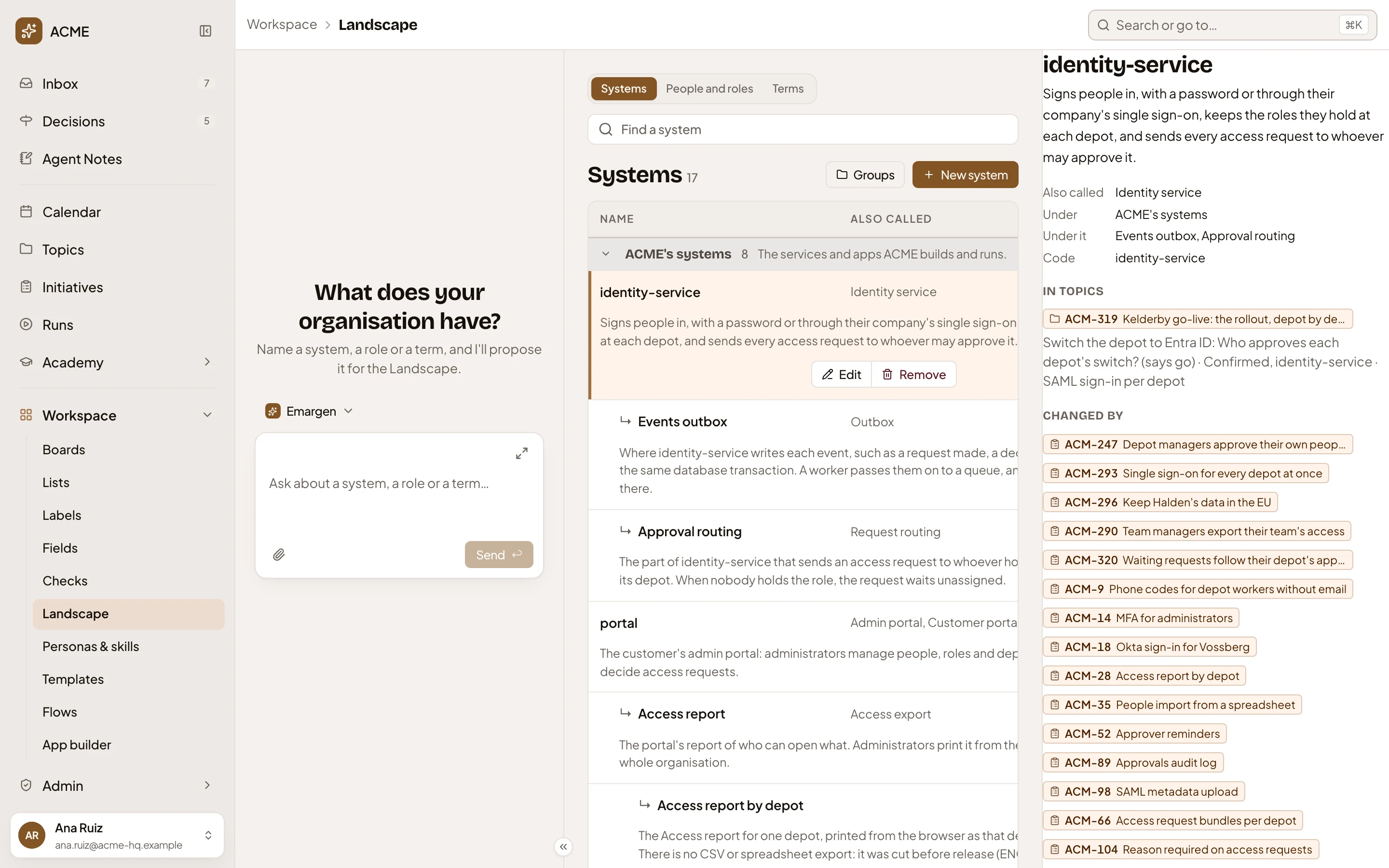
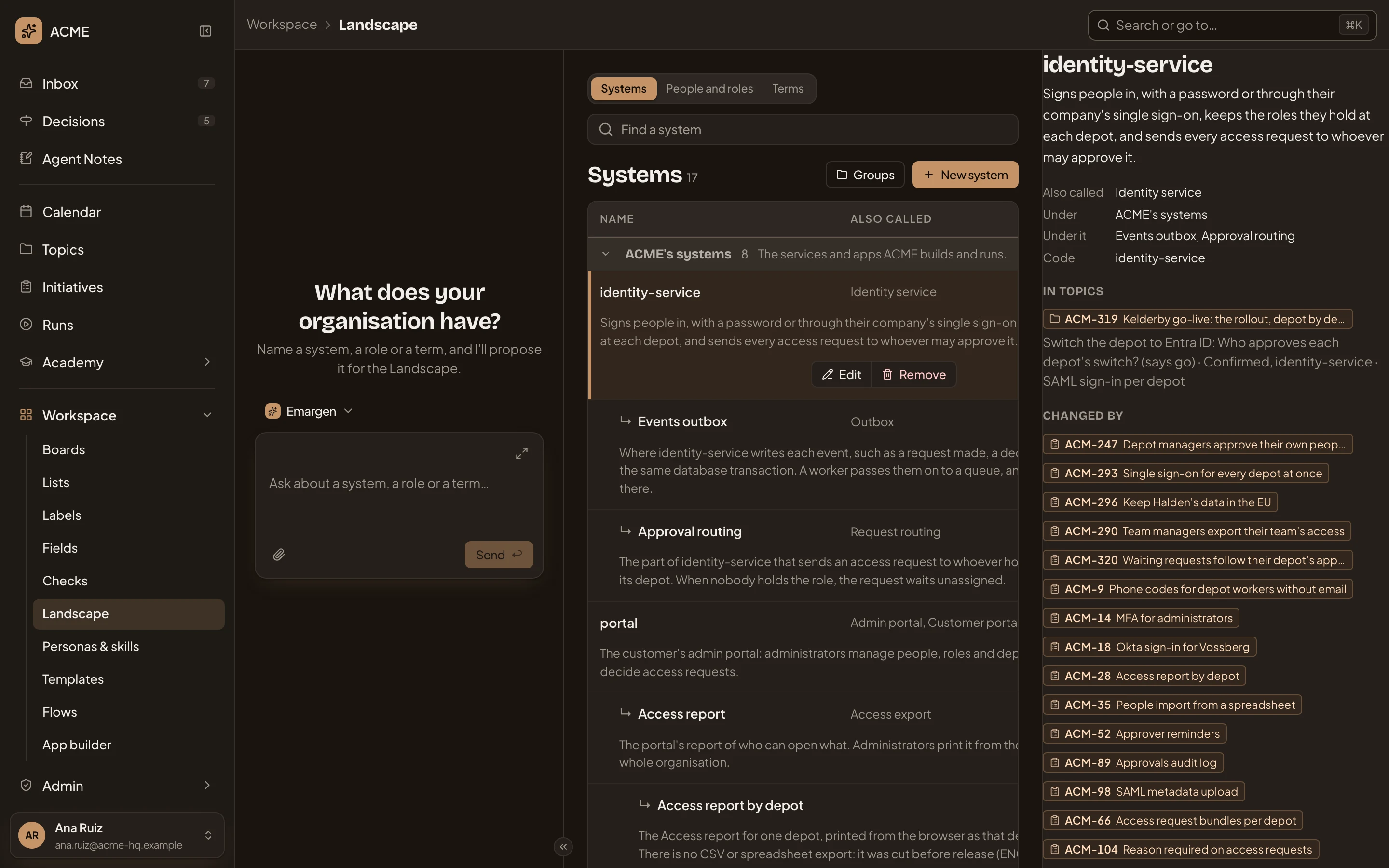
- A group your organisation names.
- Also called. Its other names, which the agents know.
- An entry under the one it’s part of.
- In topics. The topics that name it.
- Changed by. The initiatives that change it.
The agents propose what they find
Section titled “The agents propose what they find”Most entries arrive while people work. When the agent breaks down what an initiative will change and names a system or a role the Landscape lacks, it drafts a definition from the work and proposes it. If it can’t say what the name is, it proposes nothing. When it analyses a code repository, it proposes the outside systems it finds. In a topic or an initiative, you can ask the agent to propose one.
The workspace agent sits beside the Landscape’s own pages. Ask it what an entry means, or tell it what to add. It drafts the entry on the page with you, and nothing is sent until you press the button.
Nothing counts until someone approves it
Section titled “Nothing counts until someone approves it”Every change starts as a proposal, a person’s or an agent’s. The agents use a change only after an approver accepts it, and they never approve one themselves.
The approver sees who proposed it and why, and where the name turned up, with a link to the topic or initiative. They approve it, change it first, keep it as another name of an entry you already have, or reject it. If an agent finds the name again before anyone decides, it adds a source to the same proposal. An approver’s own changes apply at once.
Someone in security finishes the work that makes every new customer’s region a choice in onboarding. The Landscape has no word for that step, so they propose Region step as a term, with the finished work as the reason.
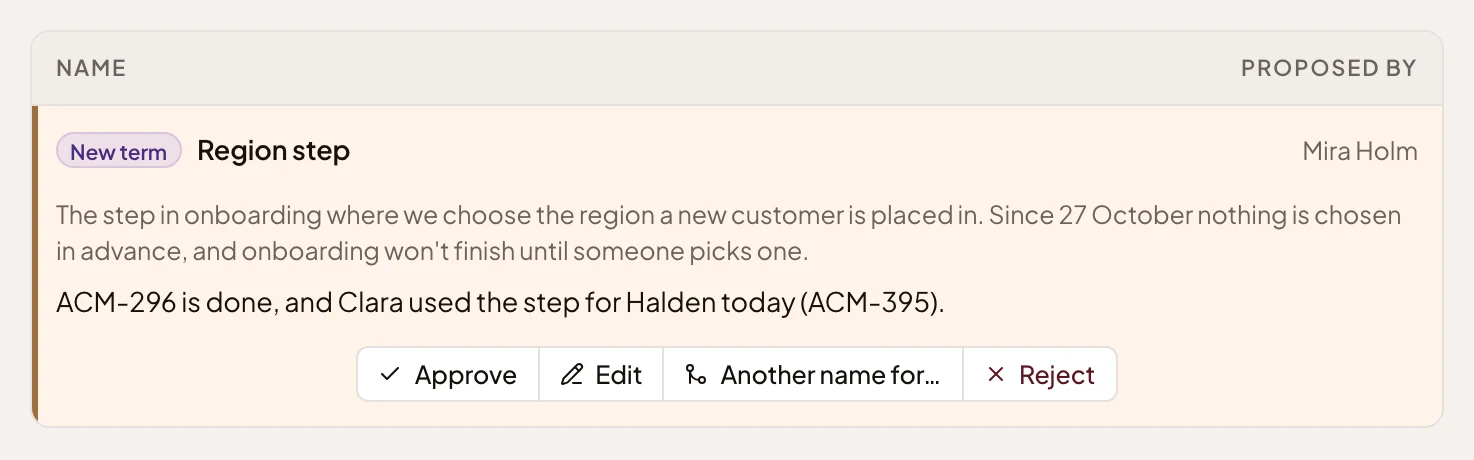
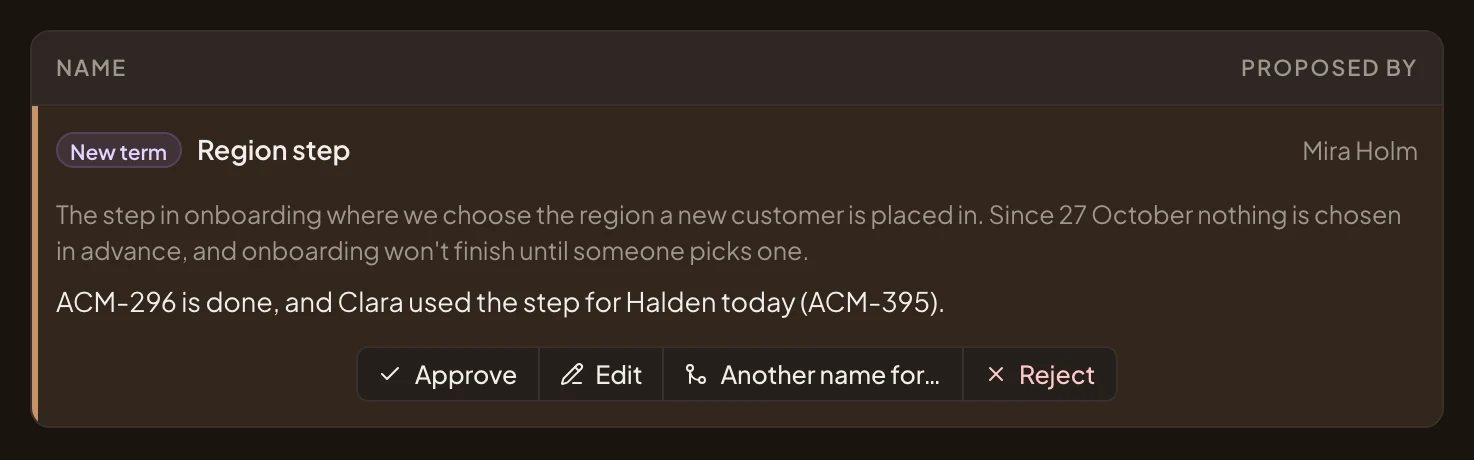
- New term. The entry it would add.
- Who proposed it.
- What it is, and why it belongs.
- Approve, Edit first, Another name for… an entry you have, or Reject.
Once it’s approved, every agent calls that step the region step, and knows what it is. The approval is a decision too, recorded with who took it.
Removing an entry changes only what the agents write next. What they wrote already keeps the name it used.
Everyone reads it
Section titled “Everyone reads it”Everyone reads the Landscape and proposes changes. Approving takes Approve landscape changes. Administrators have it, and any role can be given it. Only approvers make and keep the groups. A new organisation’s Landscape starts empty, and the agents start proposing what they find. In the Academy, people practise its words.