

AcademyIdea
Practice
Practice is a few short questions a day about your tracks, the parts of your organisation you chose to know. Each question is a card. You answer it, say how sure you are, and see what the check made of your answer. What you missed comes back sooner. What you knew comes back later each time.
Recall, not reading
Section titled “Recall, not reading”Reading tells you what your organisation knows. Only trying to recall it tells you what you know. Practice finds the facts you can’t bring back, and the ones you only thought you knew. When you’re sure and right, a fact comes back later and later. So your few minutes go to what you keep missing.
A day’s practice
Section titled “A day’s practice”On a morning when cards are due, today’s practice waits in your Inbox, with how many cards and about how long. A practice gives you up to eight cards, the most overdue first. It mixes in a few facts you haven’t met yet, at most ten new ones a day.
You get one card per fact, and a different kind of card for it from one time to the next. The first time you meet a fact, you choose from a few answers, so you recognise it before you have to write it. Later, your learning profile can steer which kind you get, towards the kind that suits you.
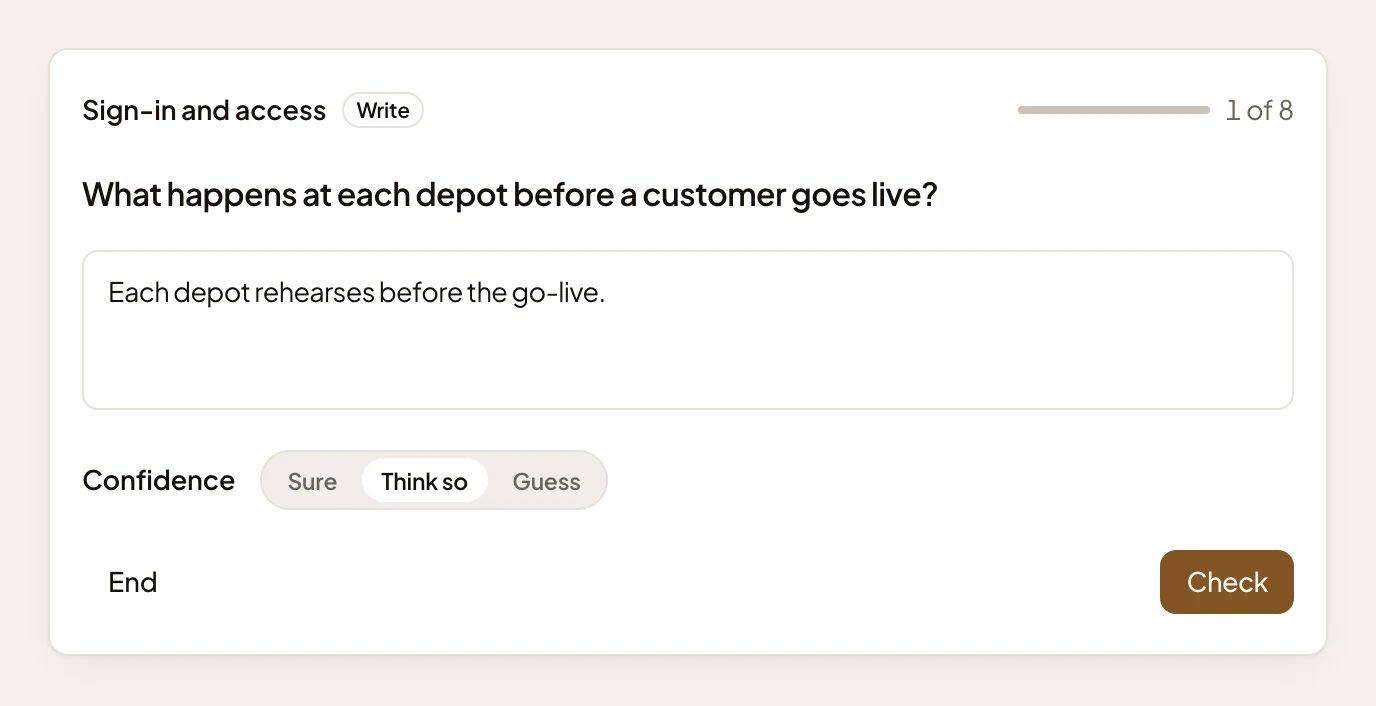
- Write, the kind of card: an answer in your own words.
- Your answer, which the check reads for its meaning.
- Confidence, how sure you are, asked before the check. Your answer and how sure you were set the next date.
- End stops the practice. The cards you didn’t answer wait.
- Check, which reads your answer and quotes what the source says.
You can also practise one track or one spot, and stop whenever you like. Cards you didn’t answer are saved and wait.
Checked by meaning
Section titled “Checked by meaning”A choice is right or wrong. In a gap, any word the fact allows counts. A written answer is read for its meaning. The check looks for the points a full answer makes, so you can be partly right. The check also says when you claimed something the source doesn’t. After a check you see what the source says, quoted. A match card shows each fact instead.
Nobody marks themselves. Your answer and how sure you were set the next date together. A miss comes back soonest, however sure you were. A right answer comes back later the surer you were, so a lucky guess returns sooner than a sure answer.
Changed facts
Section titled “Changed facts”When someone has the Academy agent rewrite a fact, its cards are marked Changed. It starts over in your practice, so it comes back within days even when you get it right. A fact that joined a track after it was built is marked New.
Two people’s practice
Section titled “Two people’s practice”Someone in customer success practises sign-in and approvals before a customer’s go-live. This morning they have eight cards, about four minutes. One asks what happens at each depot before a customer goes live. They write that each depot rehearses, say they think so, and the check finds both points a full answer covers. It quotes the Landscape and says the fact comes back in 51 days.
A sales engineer practises the words a food company uses in its security questionnaires. Their first card today asks them to complete “At a food company, a depot manager is called a ___.” Knowing it’s “site manager” means they answer the very next questionnaire in the customer’s words.
Written cards come up only when your organisation has a model set up to check them. Otherwise you get the fact’s other kinds of card. Your answers and how sure you were stay yours alone. A day you skip costs nothing but more cards the next day. A challenge checks answers the same way, but leaves your practice as it was.