

AcademyIdea
Challenges
A challenge gives you and one colleague the same few cards, the short questions the Academy asks in daily practice. You each answer alone, whenever you like. Once you’ve both finished, you see each other’s answers.
A reason to practise together
Section titled “A reason to practise together”Practising alone is easy to put off. A challenge gives you a reason to practise with someone, and shows what you both need to go over. Two engineers might compare what they know of a system before a review.
It starts at once
Section titled “It starts at once”A challenge uses cards that already exist, so there’s nothing to write and nothing to wait for. You pick what it’s on. That can be one of your tracks, a region of the Landscape, or single spots, one thing each. You choose 5, 10 or 20 cards. It takes one card per fact and covers as many spots as it can. If there aren’t enough facts, you get fewer cards. The person you challenge gets it in their Inbox, and answers when they like.
Emargen checks each answer as practice does. It says whether you were right, partly right or not quite, quotes the source, and gives the answer when yours wasn’t right. A challenge never asks how sure you are. It doesn’t count as practice, so your schedule and your map stay as they were. The challenge draws a small map of its own, coloured by your answers.
Once you’ve both finished, each of you sees the other’s answers to that challenge’s cards, and nothing else. Whoever finished first hears when the other does. Emargen keeps nothing on anyone’s profile.
Keeping what you missed
Section titled “Keeping what you missed”Once you’ve finished, either of you can keep the challenge as a track of your own. It’s built like any track, so what you tested yourself on joins your daily practice.
Before a customer’s security call, a sales engineer challenges a colleague in customer success on five cards. They each get four right, and miss different ones. One calls a food company’s depot manager a team manager, when it’s a site manager. The other thinks the notifier writes to an approver once a request is approved. It writes while the request is waiting. Each now knows the one thing to check before the call.
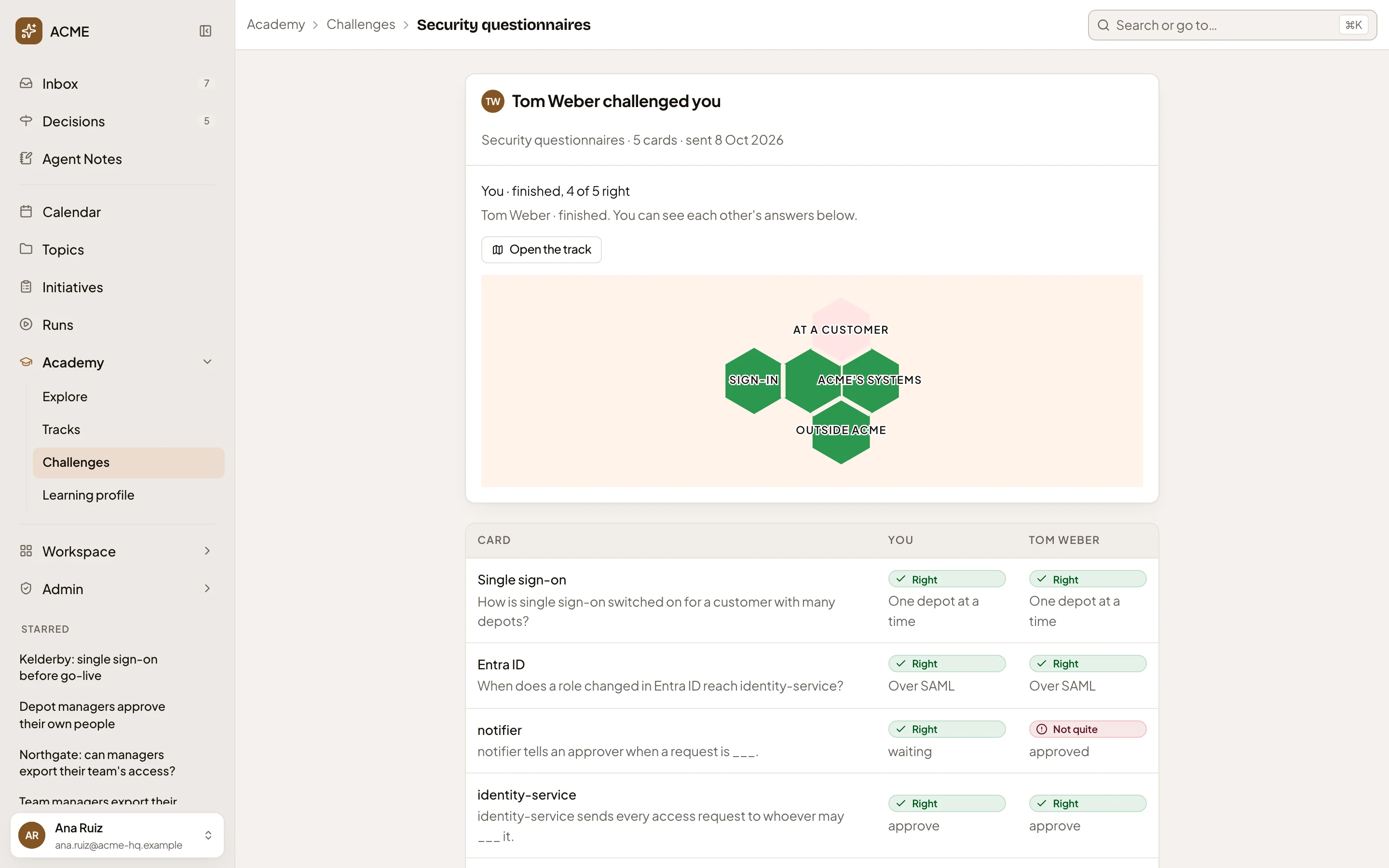
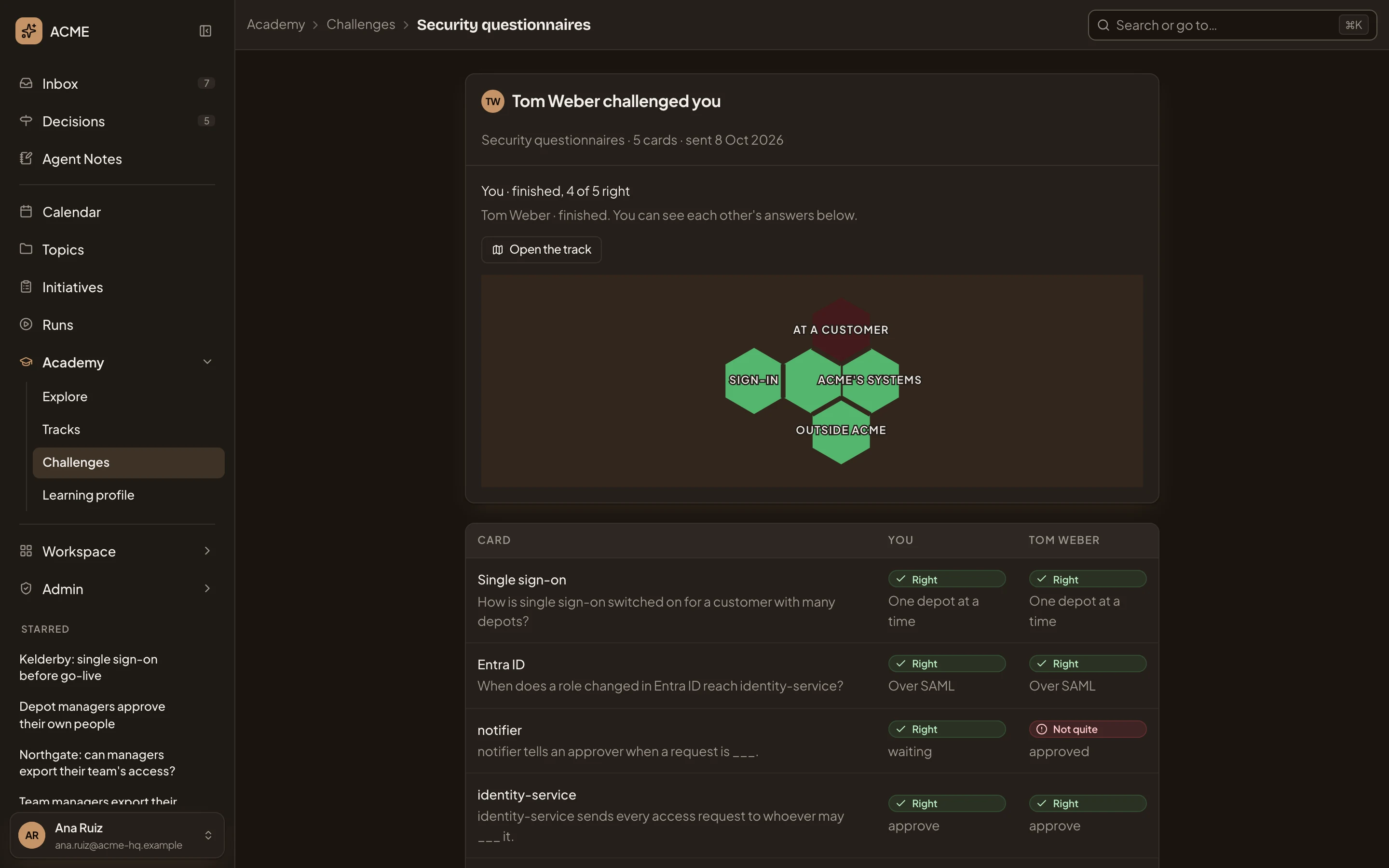
- Who challenged you, and on which track.
- How you did. Your colleague’s line under it says they’ve finished too.
- The challenge’s spots on a small map, coloured by your answers.
- Your colleague’s answers beside yours, once you’ve both finished.
- A card one of you got wrong, marked Not quite.
Anyone can challenge anyone else in the organisation, and only the two of you see it. Emargen adds written cards to a challenge only when your organisation has a model set up to check them.