

DecisionsIdea
The Decision Map
The Decision Map is the record of what was decided in everything you can open in Emargen. It shows when each decision was taken, where, by whom, and why. What’s still open is drawn beside it.
A record nobody had to write
Section titled “A record nobody had to write”Decisions get taken one at a time, all over the place. A question answered on an initiative. A requirement made a must. A choice agreed in a topic. Each is kept where it was taken, and a month later nobody can say what was decided about single sign-on, or why a requirement was dropped. So someone asks again, and gets a different answer.
The map puts them on one page. Each decision is a press away from where it was taken, and from the reasons kept with it.
A decision here is a person’s call, made in a topic, an initiative or the Landscape. Something the agent chose on its own doesn’t count until a person signs it. Comments, replies and todos don’t count either.
Lanes over time
Section titled “Lanes over time”Map is the second page of Decisions. It shows decisions over time, grouped by where they were made, beside what’s still open and what’s holding work up.
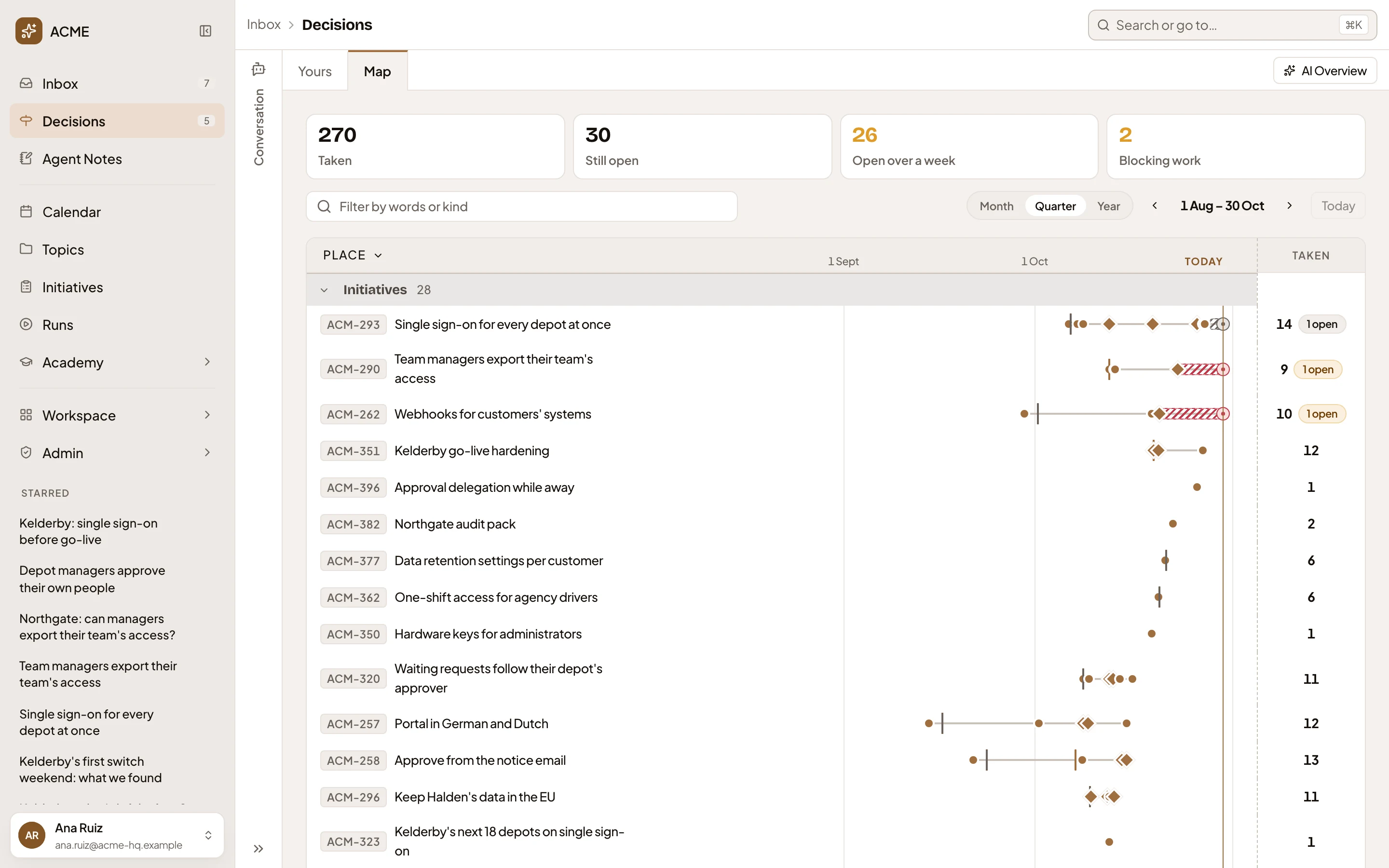
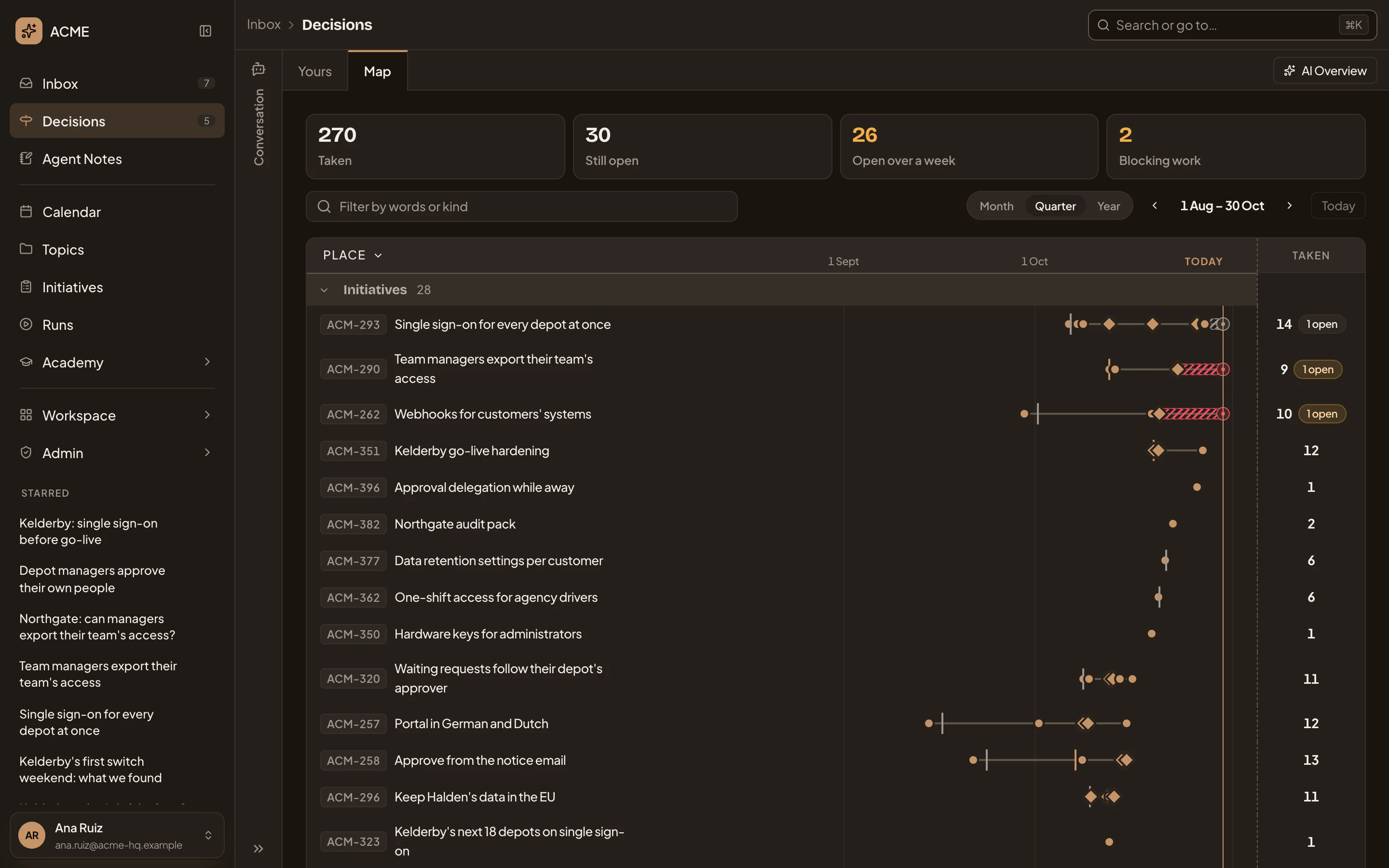
- Map, the second page of Decisions.
- AI Overview. The agent reads the map to you, citing the decisions it rests on.
- Decisions taken, still open, open over a week, and blocking work.
- Place. What the lanes are: here, where each decision was made.
- One initiative’s lane, a mark on each day a decision was taken there.
- What’s still open, on today’s line.
A decision’s own page
Section titled “A decision’s own page”You see what was on the table and why it was chosen, who raised it and who chose. When someone asked the agent to check something first, what it found stays beside it.
The agent finds the later decisions that build on this one. You can confirm that a later decision replaced it, and you can see which replaced which.
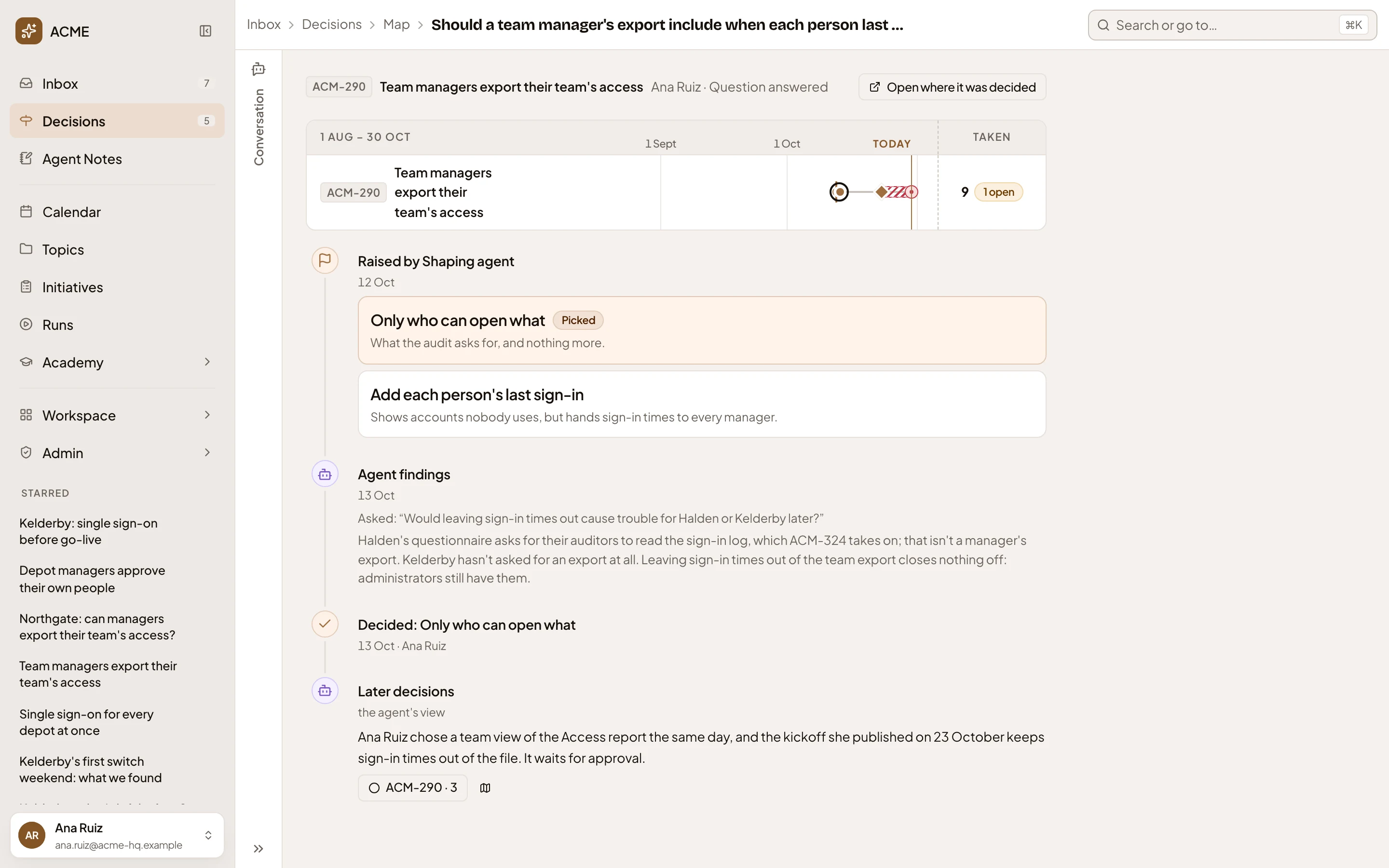
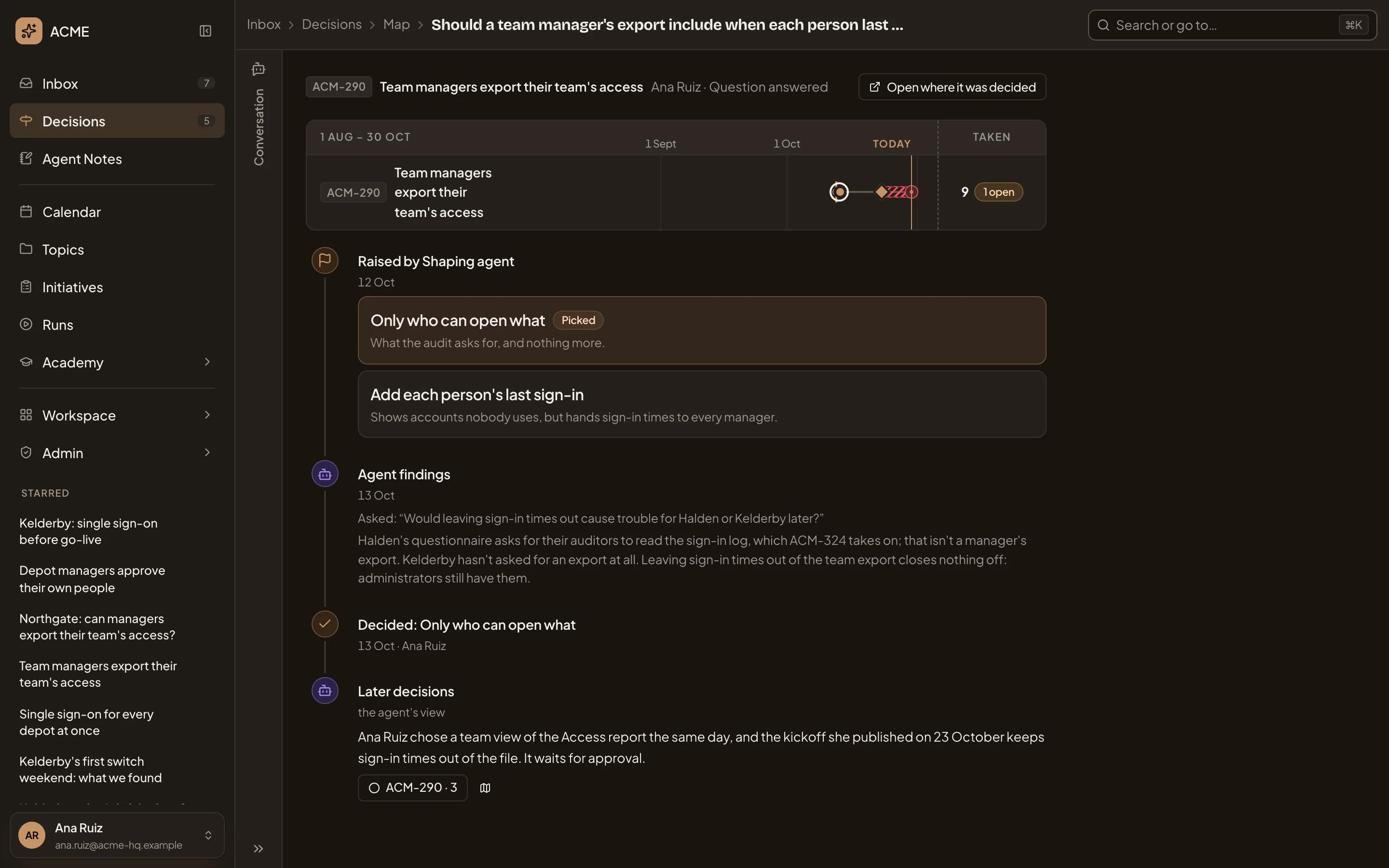
- Open where it was decided. The initiative or topic it was taken in.
- Its initiative’s decisions on one lane, with this one ringed.
- The options it was raised with. Picked marks the one chosen.
- Agent findings. What the agent found when someone asked it first.
- Who chose, and when.
- Later decisions. The agent’s reading of later decisions that build on this one.
AI Overview
Section titled “AI Overview”AI Overview The agent reads the map to you. It summarises the decisions and what’s still open. Every sentence cites the decisions it rests on, so you can open each one and check. It also gathers decisions on the same subject from different places.
The other views are counted from the decisions themselves. They show what changed in scope, how often people followed the agent’s recommendation, and how often they gave a reason. You can ask your own question, save it as a view, and share it. What you share is the question. Each reader’s answer is written from what they can open.
Someone in support with a customer call this afternoon can read what was promised about that customer’s single sign-on, and who promised it, without asking anyone.
The same map for everyone
Section titled “The same map for everyone”We made one map for everyone, not a page for each role. A leader and a product manager see the same map. They differ only in what they can open. A private topic stays off everyone else’s map, and out of what the agent reads for them.