

AcademyIdea
Tracks and spots
A track is a part of your organisation you choose to know, framed with the Academy agent in a short chat. It covers spots, each one thing worth knowing. Each spot has facts to learn, and cards to practise them. You practise a few cards a day until you can recall the facts at work.
Your choice of what to know
Section titled “Your choice of what to know”Nobody needs to know everything an organisation holds. An engineer joining a team needs that team’s systems. Someone in customer success, before a customer’s go-live, needs sign-in and approvals well enough to explain them. A track is that choice, so practice covers what matters to you, and goes as deep as you asked.
Spots, facts and cards
Section titled “Spots, facts and cards”A spot is one thing worth knowing. Today a spot is an entry in your organisation’s Landscape, its agreed descriptions of its systems, roles and terms. It might be a system like identity-service, a role, or a term like Approver. What a track teaches about a system is what its Landscape entry says, not its code or its documents. Emargen’s own ideas are spots too, written from these docs.
A fact is one claim about a spot, with the points a written answer must cover. A card asks a fact one way. You choose one answer, complete a sentence, write it in your own words, or match names to definitions. A fact has several cards, so you learn the fact and not one question’s wording.
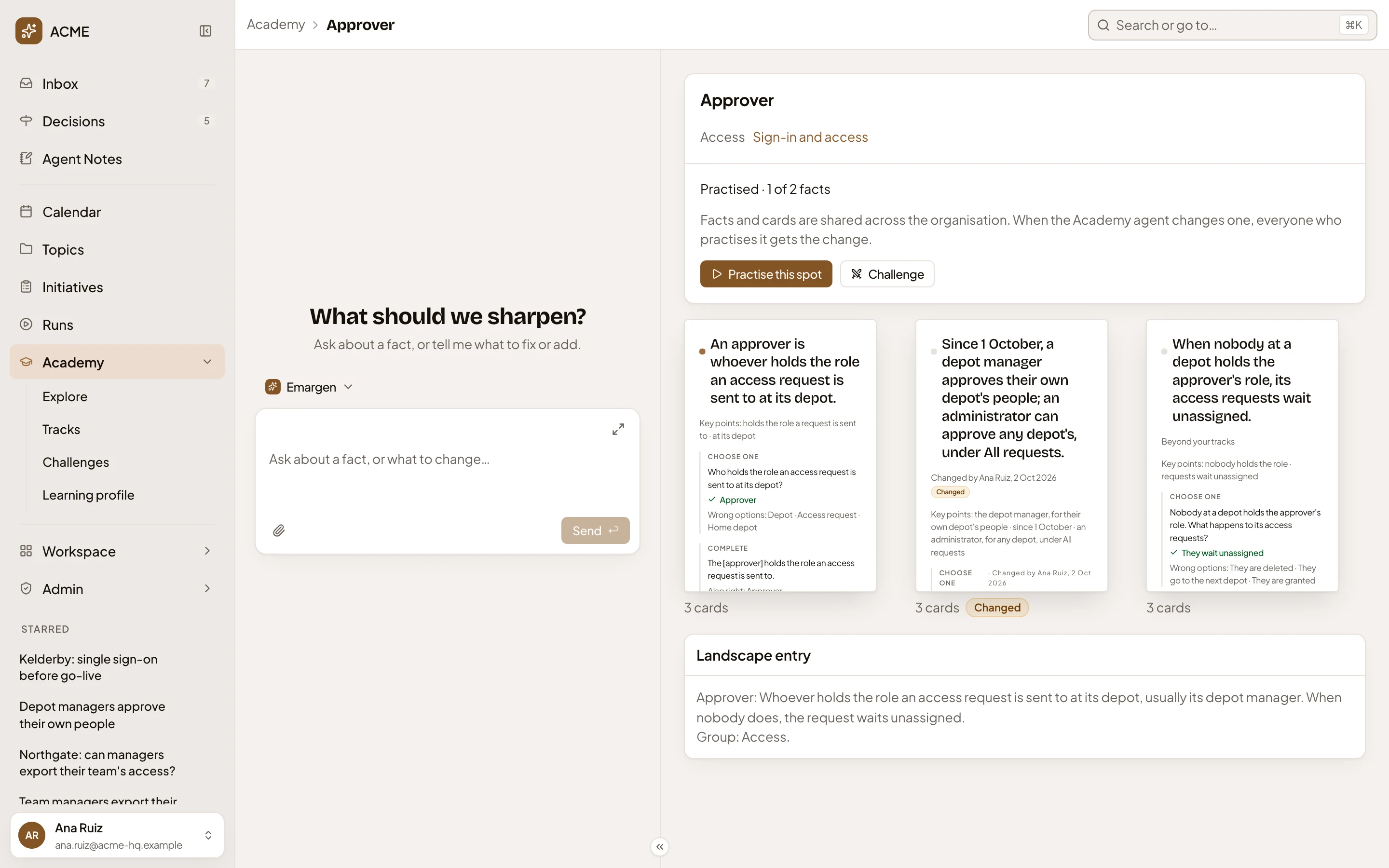
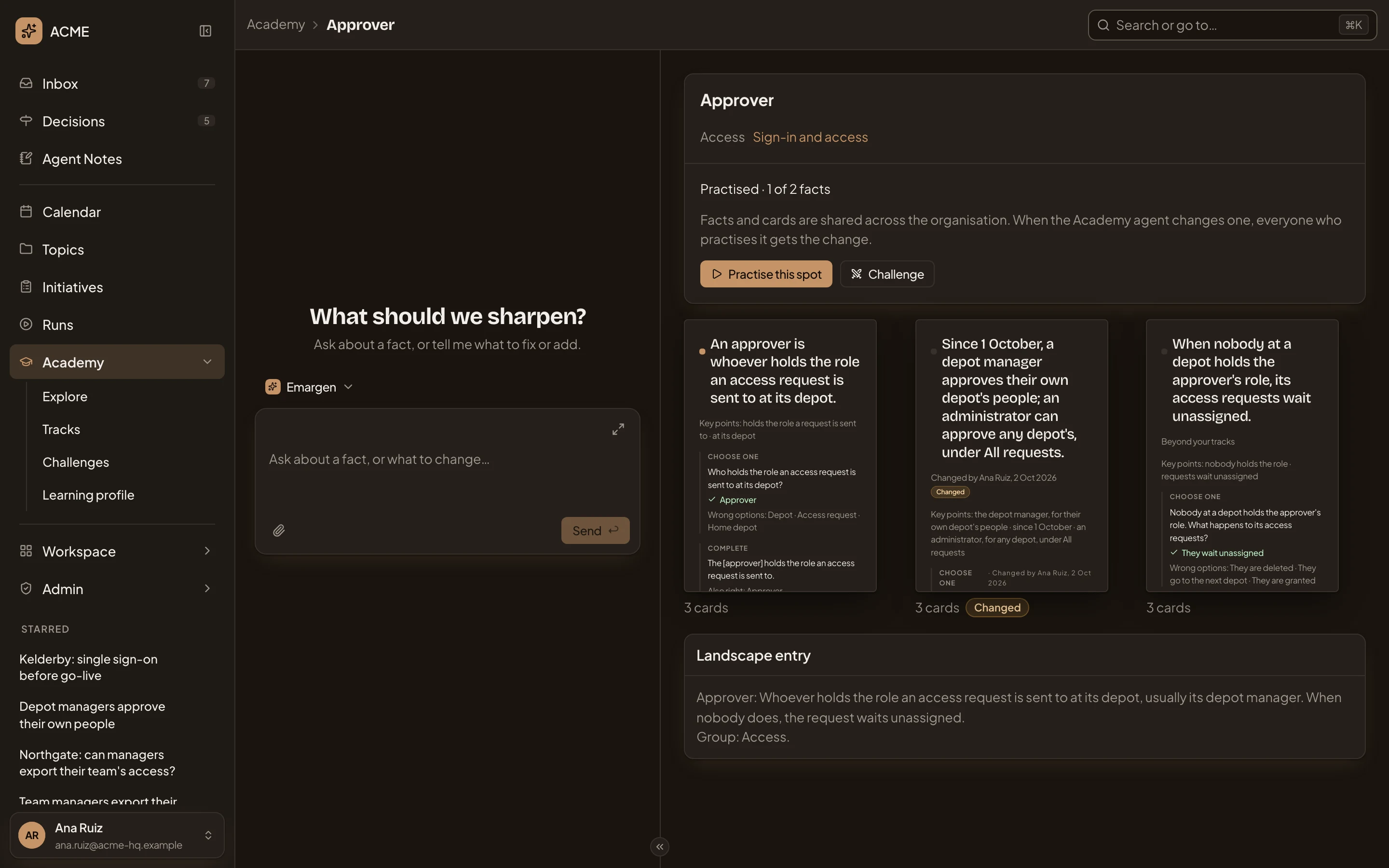
- Your chat with the Academy agent. Ask it to rewrite a fact, and the change reaches everyone who practises the spot.
- Practise this spot, to practise only its cards.
- A fact, drawn as a page: its claim, the points a written answer covers, and its cards.
- The fact rewritten when depot managers started approving their own people, marked Changed.
- Landscape entry, what the facts are written from.
Spots, facts and cards belong to the organisation. They’re written once and practised by everyone whose tracks cover the spot. Only your memory of each fact is yours. How well you’d recall it, and when it comes back.
So when a fact reads wrong, anyone who practises it asks the Academy agent to sharpen it. Everyone who practises it sees it marked Changed, and it starts over in their practice. A fact that joins a spot later is marked New.
Framing a track
Section titled “Framing a track”You start a track on Tracks by telling the Academy agent what you want to know and why. It looks through the Landscape, picks the spots your request touches and shows them on your map. Then it asks a few questions, one at a time. It skips any your first message already answered.
- What you’ll do with it, like explain it to customers or build it.
- How deep to go, from the names and what each part does, to the rules and edge cases.
- Which of its picks to leave out.
- Which you know well already, so those start later.
If you name something the Landscape doesn’t hold, it says so instead of making it up. A track can also start from a suggestion on Tracks, or from a line of your learning profile. The agent builds those at once, without the questions.
Building it
Section titled “Building it”You start the build. The agent never does. It then drafts the track in the background, a spot at a time. It writes each spot’s facts and cards from its entry and checks each fact against it. When another track already drafted a spot, the agent uses it as it is, unless its Landscape entry changed since. You can practise what’s ready while the rest is written, and your Inbox tells you when the whole track is.
Afterwards you change a track in your Academy chat beside it. Ask it to add a spot, take one out, or sharpen a fact. Your tracks are yours alone, and nobody else sees them. Anyone can open a spot’s page, since its facts are everyone’s. To change a spot, it has to be in one of your tracks.